

 +91 97699 40000
How Slimline Aluminium Doors Enhance Visual Connectivity with Outdoors
 Published: July 31, 2026Last Updated: July 31, 2026
TL;DR: Slimline aluminium doors are transforming how Indian homes relate to their surroundings, replacing bulky frames with elegant, near-invisible profiles that let the outdoors flow directly into interior spaces. This article explores how slim aluminium doors work, why they’ve become architects’ preferred solution for panoramic connectivity, and what to consider when specifying them for your home.
There’s a particular moment in a well-designed home when you look toward a garden, a terrace, or a view, and realise you’re no longer entirely sure where the room ends, and the outdoors begins. The threshold between inside and out has become so quietly resolved that the eye simply passes through it, unimpeded, to whatever lies beyond. This is not an accident.
It is the deliberate architectural outcome of choosing slim aluminium doors, systems engineered to reduce the visual barrier between interior and exterior to something close to invisible. The pursuit of this seamless connection has been one of the defining shifts in premium residential design over the past decade. And it’s slimline aluminium doors, more than any other element, that have made it genuinely achievable in Indian homes.
Why Slim Profiles Matter for Visual Connectivity?
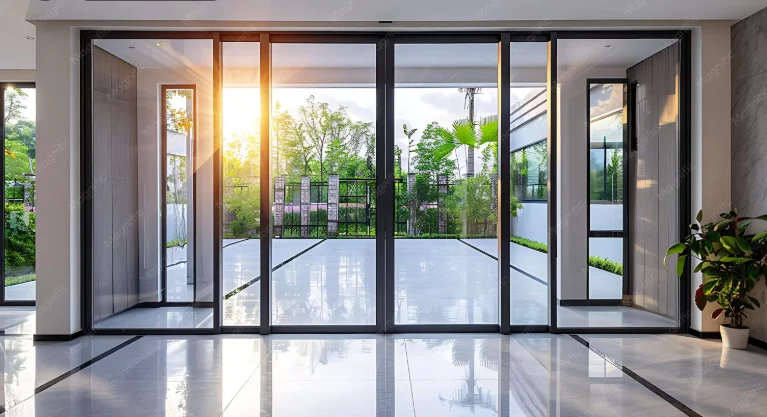
The relationship between frame width and visual openness is more direct than most homeowners appreciate. Every millimetre of the visible frame is a millimetre that isn’t glass, and across a wide door opening, those millimetres add up to something that either supports or undermines the entire design intent.
Consider a typical patio door opening with a width of 4,000mm. With standard aluminium door frames of 60mm sightline, the visible framework across that opening totals roughly 200mm, a substantial vertical presence that reads clearly against the view beyond. With slim aluminium doors achieving 20mm sightlines, the same opening has just 60mm of visible framework, distributed as slender lines rather than dominant elements. The view becomes the composition; the frame becomes a suggestion.
This visual difference has practical consequences for how the room feels. Bulky frames create a sense of enclosure even when the door is closed. Slimline profiles allow the eye to flow uninterrupted to the exterior, making the room feel larger, more open, and more connected to whatever landscape or view lies beyond. Modern aluminium sliding doors built from high-strength alloys like Duranium, which is 40% stronger than standard aluminium, are what make this level of slimness structurally viable.
How Slimline Aluminium Sliding Doors Transform Rooms?
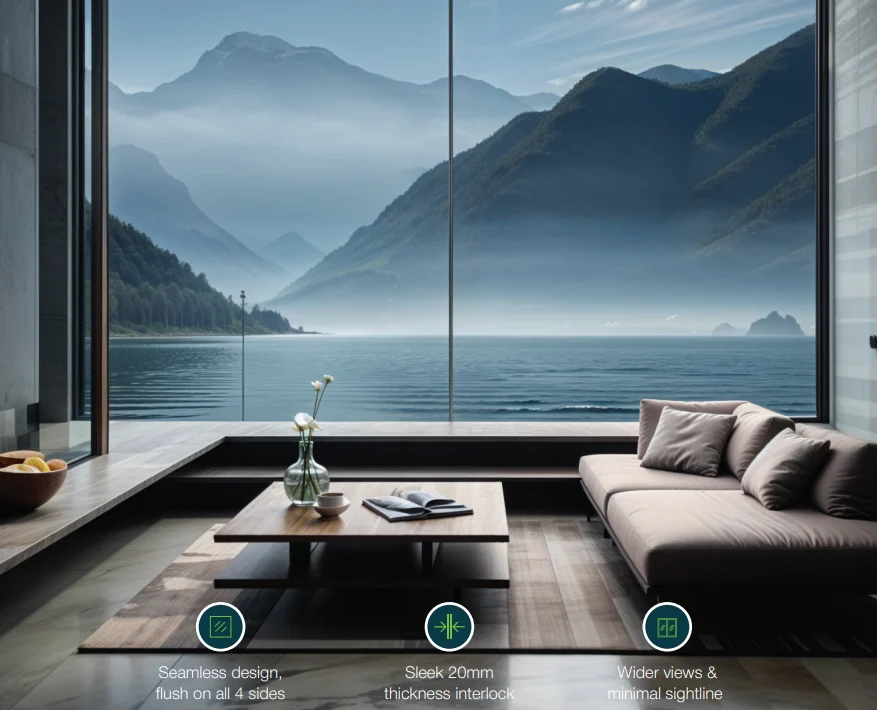
The sliding door is the natural home for slimline aluminium design. Because sliding panels move laterally rather than swinging into the room, the entire opening can be devoted to glass without the interior interference of a door swing. Combined with slim profiles, the result is closer to a movable glass wall than a conventional door.
Slimline aluminium sliding doors are increasingly the default choice for homes designed with living-room-to-terrace connections, kitchen-to-garden openings, or bedroom-to-balcony transitions. When fully closed, they preserve the visual connection to the outdoors with minimal frame intrusion. When opened, they slide away to reveal the entire opening, dissolving the boundary between rooms and outdoor spaces so completely that the two feel continuous.
Eternia’s Duraslim Edge Minimal system illustrates what slim aluminium sliding doors can achieve. With a sightline of just 20mm, panel sizes up to 4,500mm tall and 2,500mm wide, and panel weights up to 500 kilograms per shutter, it delivers the kind of expansive, elegantly framed glazing that architects specify when the goal is genuine seamlessness. Flush-on-all-four-sides installation ensures the door reads as glass set within the wall rather than as glass set within a visible frame.
The Lift and Slide Door: Slimline Engineering at Scale
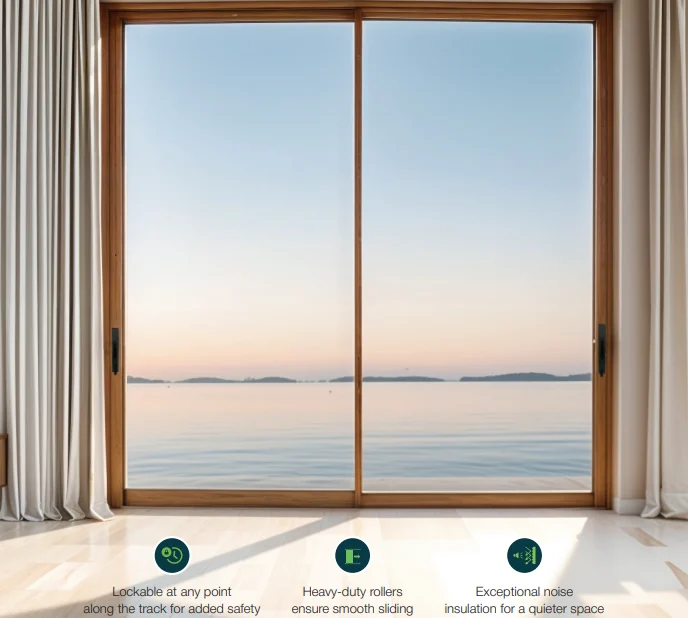
For truly ambitious openings, the kind that span an entire living room wall or an outdoor entertaining area, the lift-and-slide door is where slim aluminium doors and structural engineering meet at their most impressive.
The mechanism is straightforward in principle but sophisticated in execution. When the handle is engaged, the panel lifts slightly off its bottom seal, releasing it to slide effortlessly along the track. When returned to the closed position, it lowers back onto the seal, creating a compression closure that delivers exceptional weather performance. The practical effect is that panels weighing hundreds of kilograms, glass alone can weigh over 200 kg for large formats, can be moved by a single person with almost no effort.
Eternia’s Duraslim Edge Lift & Slide combines this mechanism with slim profiles to achieve 20–29mm sightlines. Panels of up to 400 kilograms glide on cycle-tested heavy-duty rollers. The system is certified to a WiWA score of 10/10, meaning the slim aesthetic doesn’t come at the cost of weather performance; it handles wind loads up to 2.75kPa and water ingress up to 600Pa.
Multiple track and shutter configurations, from 2-track-2-shutter through to 3-track-6-shutter setups, allow architects to design openings of virtually any scale while preserving the slimline visual language throughout.
Fold and Slide Doors for Complete Openings
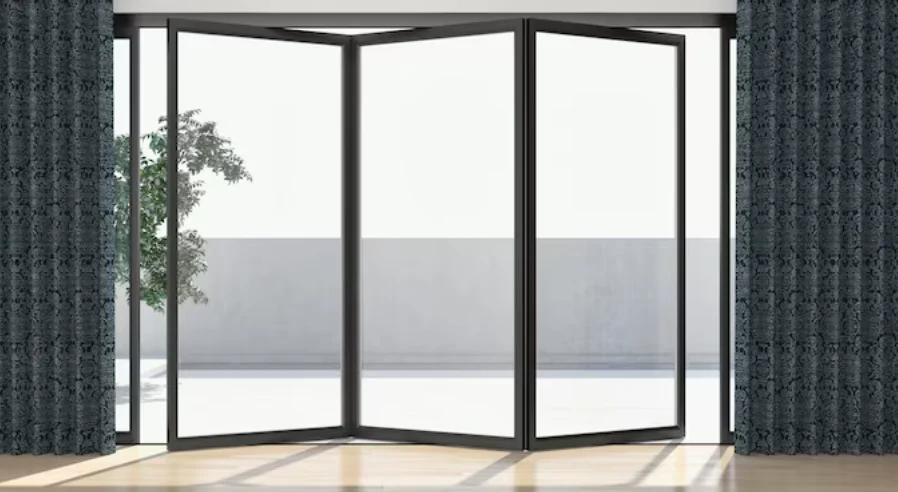
For homeowners who want the entire opening to disappear, not just slide to one side but stack away completely, fold and slide doors offer another approach to the same fundamental goal of visual connectivity with outdoors.
The mechanism uses multiple hinged panels that fold against each other and slide along a track, allowing the full width of the opening to be cleared when the door is fully open. Where a sliding door reveals half or two-thirds of its opening depending on the track configuration, a fold and slide door can reveal essentially 100 per cent, turning a wall of glass into an unobstructed threshold between inside and out.
This makes fold and slide systems particularly compelling for homes designed around outdoor entertaining or indoor-outdoor living. A living room facing a garden, when fitted with a fold and slide door across its outdoor-facing wall, effectively doubles in size when the door is opened. Guests move freely between spaces. Air flows without obstruction. The rigid distinction between interior and exterior, so central to conventional architecture, gives way to something more fluid and generous.
Eternia’s Duraslim Edge Slide & Fold system supports panel heights up to 3,000mm and is WiWA-certified for wind, water, and air performance. Multiple pattern configurations, from simple 3-panel setups to complex 7-panel arrangements, accommodate openings of varying scale and geometry. The heavy-duty hinges and seamless bottom-track design ensure that, even at maximum extension, the system operates smoothly and seals reliably.
Choosing the Right Slim Aluminium Door for Your Home
The choice between slimline sliding, lift and slide, and fold and slide systems isn’t a matter of one being universally better; it’s about matching the system to the specific opening, use pattern, and architectural intent.
Slimline aluminium sliding doors work best where you want a consistently open visual connection with occasional operable access, living room to terrace transitions, bedroom to balcony openings, and similar configurations where the door is opened for use rather than for a permanent dissolution of the boundary.
Lift and slide doors are the right choice for larger openings where panel weight becomes significant and effortless operation matters. They’re also the strongest performers for coastal or high-wind locations, where their compression sealing delivers superior weather resistance.
Fold and slide doors suit openings where complete clearance is the priority, outdoor kitchens, entertaining spaces, and homes designed around specific indoor-outdoor lifestyle patterns. They’re the most dramatic option and, when used well, deliver the most complete transformation of the room-to-outdoor relationship.
Across all three, the underlying principle is consistent. The slimmer the profile, the more successful the visual connection. The higher the performance certification, the more reliably that connection is maintained across India’s demanding conditions. And the better the hardware, the longer the everyday experience feels effortless. These are the three variables to prioritise when specifying slim aluminium doors for any home.
Conclusion
Slimline aluminium doors have quietly become one of the most impactful design decisions available in contemporary Indian residential architecture. Not because they’re dramatic in isolation, but because they enable a fundamental change in how a home relates to its surroundings, replacing the psychological weight of a solid boundary with the elegant permeability of glass held within near-invisible frames.
For homeowners designing new builds or planning significant renovations, the case for specifying slim aluminium doors is strong wherever visual connectivity with outdoors matters. The technology is mature. The performance is proven. The everyday result, a home that feels open, generous, and connected to the world beyond its walls, is one of the most enduring rewards that considered residential design can deliver.


How to Prevent Dust from Entering Home Through Windows
Best Aluminium Windows for Humid and Rainy Climates

Are Aluminium Windows Good for Monsoon? Everything Homeowners Should Know

5 Signs It’s Time to Replace Your Old Windows
Aluminium Window Design Ideas to Refresh Your Home This Festive Season

How Aluminium Windows Can Make Your Home Brighter for Festive Celebrations
The Ultimate Buying Guide to Aluminium Windows and Doors for Modern Homes
Window Pane Design Ideas for Modern Homes and Luxury Interiors

Modern Corner Window Designs That Maximise Views and Natural Light
Toughened Glass Windows: Why Every Modern Home Should Consider Them
Frequently Asked Questions
20–30mm sightlines are considered genuinely slimline in premium aluminium door systems. Eternia's Duraslim Edge Minimal achieves 20mm, among the narrowest available in the Indian market, made possible by the Duranium alloy's 40% additional strength over standard aluminium.
Yes, when specified with appropriate performance certification. Systems like Eternia's Duraslim Edge Lift & Slide carry WiWA scores of 10/10 across wind, water, and air performance, meaning slimline aesthetics coexist with the structural resilience needed for demanding environmental conditions.
Slimline sliding doors move on continuous rollers along a track. Lift and slide doors mechanically raise the panel off its seals during operation, allowing much larger and heavier panels to move effortlessly and delivering superior compression sealing when closed. Lift and slide systems suit larger openings and demanding weather conditions.
Yes. Slimline systems support the full range of premium glass options, double glazing, acoustic laminated glass, tinted glass, and low-emissivity coatings. The slim profile doesn't limit glass specification; it simply frames whatever glass is chosen with minimal visual intrusion.
Very little. Aluminium doesn't warp, corrode, or require repainting. Periodic cleaning of tracks and occasional lubrication of rollers is generally sufficient. Cycle-tested hardware in premium systems like Eternia's is engineered to maintain smooth operation for many years without significant intervention.


Our consultants will give a closer Look!
WHATSAPP VIDEO CALL AT YOUR CONVENIENCE
Schedule a Video call or Request Real Images and Videos