

 +91 97699 40000
Aluminium Window Warranties Explained: What Indian Homeowners Must Know Before Buying
 September 15, 2026
TL;DR: Read the warranty before you buy, not after something breaks. It tells you how long the maker thinks the window will last and which parts they’ll actually pay to fix. Look for separate coverage on the frame and the hardware, check what’s excluded, and find out who handles claims near you. A long, clearly written warranty is usually a sign of a well-built window. A short, vague one should make you pause.
Picture this. It’s year six. One of your sliding windows has started dragging, the handle feels loose, and you dig out the warranty card for the first time. Turns out the “warranty” you were so pleased about only covered the hardware for two years. The frame’s fine, but the part that’s actually failing is on you now.
This happens more than you’d think, mostly because nobody reads the warranty at the point where it could still change their decision. So let’s fix that.
Why is the warranty worth your ten minutes?
Honestly? It’s the most truthful document in the whole buying process. Brochures are marketing. Sales pitches are sales pitches. A warranty is the company saying, in writing, “if this fails, we’ll pay.” Nobody makes that promise lightly on a product they don’t trust, because every claim costs them.
That’s why the length and scope of a warranty tells you so much about aluminium windows for home. It’s the maker’s own opinion of its product, just written in legal language.
What should it actually cover?
A window is several things bolted together, and they don’t age at the same pace. A decent warranty treats them separately.
The frame, or profile, is the aluminium itself. It should get the longest cover by some distance, since a properly made frame has no business warping or corroding for many years.
The hardware is the stuff you touch daily. Rollers, hinges, handles, locks. It wears faster, so a shorter term is fair enough, but “shorter” shouldn’t mean “barely there.”
Then there are the two questions people forget to ask. Is the glass covered? And if the installation was botched, whose problem is that? Some warranties cover the product and stay silent on the fitting. If everything’s crammed into one line that just says “5-year warranty,” push for detail.
So how long is long enough?
There’s no official number, but for premium aluminium windows you’d want frame cover that runs well past a decade and a few genuine years on the hardware.
As a reference point, Eternia gives 12 years on profiles and 5 years on hardware. The gap between those two figures isn’t a trick; it’s just realistic. Frames are built for decades. Rollers and hinges work every day and are expected to wear sooner.
When you’re comparing high quality aluminium windows, set the quotes next to each other and go part by part. A family in Pune did exactly this with two quotes. One offered a flat “5-year warranty,” no breakdown. The other split profile and hardware cover, with the frame covered for far longer. The second was pricier upfront. For a home they meant to live in for twenty years, it wasn’t a hard choice.
The fine print that catches people out
Exclusions. Nobody reads them until they need to, and then it’s too late.
The common ones are pretty standard: the window was fitted by someone who isn’t an authorised installer, it was damaged by misuse or an accident, or it was altered after installation. Some warranties also exclude extreme weather damage or problems caused by the building itself moving. None of this is shady; it’s just how warranties work. You simply want to know about it before you sign rather than when you’re filing a claim.
Before you sign, do this
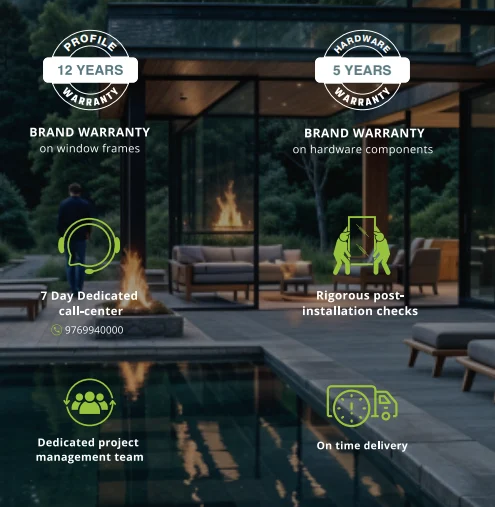
Get the warranty in writing before you commit, not stapled to the invoice afterwards. Read it part by part. Compare it against your other quotes line by line, not headline figure against headline figure. Go through the exclusions properly. Ask who you’d actually call if something went wrong and whether they have service people in your city.
And keep the paperwork together. Invoice, warranty card, installation details, one folder. It sounds too basic to mention, but it’s the step that trips up the most people.
Why better windows come with longer cover
This isn’t a coincidence. A company can only afford to promise twelve years on a frame if its frames genuinely last that long; otherwise, the claims would bury it.
So longer cover usually traces back to better materials and more testing. Eternia’s systems are built on Duranium, a special aluminium alloy Hindalco developed that’s 40% stronger than regular aluminium, which is a big part of why its aluminium framed windows hold their shape over decades. The rollers in its aluminium sliding windows and the hinges in its aluminium casement windows are cycle-tested, and that’s what makes a five-year hardware warranty a comfortable promise instead of a risky one. The best aluminium windows tend to come with the best cover for exactly this reason.
Final Words
A warranty won’t make a window look any better on the day it’s installed. What it does is tell you what happens in year eight, and who answers the phone. That’s worth a careful read before you’ve paid, while it can still change your mind.
Want aluminium windows with cover you can actually rely on? Explore Eternia’s premium aluminium windows, backed by a 12-year warranty on profiles and 5 years on hardware. Call Us Now

Aluminium vs Wooden Bathroom Doors: Why Modern Homeowners Are Making the Switch

Choosing Aluminium Windows for Homes with Children: Design and Safety Factors

Future of Aluminium Windows and Doors in India – 2026 Technology Trends
Aluminium Windows for Ground Floor Homes: Privacy, Security & Ventilation Balance

How Aluminium Windows Affect Home Resale Value in India: Real Estate Expert Insights

How Aluminium Window Design Can Influence the First Impression of Your Home?

Noise Pollution Solutions: Best Aluminium Windows for Homes Near Roads, Railways & Airports
Aluminium Window Warranties Explained: What Indian Homeowners Must Know Before Buying

Best Aluminium Window Orientations for Indian Homes: North, South, East, West Guide

Top Aluminium Windows and Door Designs for Luxury Farmhouses in 2026
Frequently Asked Questions
Normally, the frame and the hardware, and sometimes the glass and installation too. The frame almost always gets the longest term. Since this varies so much between brands, check each part rather than trusting the headline figure.
Because it's the part that moves. Rollers and hinges get used every day, so they wear faster than a frame. A shorter term is normal, as long as it's still a sensible length.
Mostly, yes, but read it. Twelve years with a page of exclusions can be worth less than a slightly shorter warranty that's clear and broad.
It can. Many brands require an authorised installer. Check before you book anyone, and keep the installation records.
Contact the manufacturer or dealer with your invoice and warranty details and describe the problem. Don't attempt a repair yourself, since that can affect your cover.


Our consultants will give a closer Look!
WHATSAPP VIDEO CALL AT YOUR CONVENIENCE
Schedule a Video call or Request Real Images and Videos